

Morocco has one of the richest Jewish heritages in the Arab world, and much of it can still be visited. The best places to start are the mellahs, the historic Jewish quarters, of Marrakech, Fez and Essaouira, along with their restored synagogues and cemeteries, Essaouira’s Bayt Dakira house of memory and the Museum of Moroccan Judaism in Casablanca. Jewish communities lived in Morocco for more than two thousand years, and the country’s 2011 constitution names Hebrew heritage as part of Moroccan national identity.
Here is where to go, and how to combine these places into one trip.
Essaouira: the heart of a heritage trip
In the 19th century, Jewish merchants made up a large part of Essaouira’s population and much of its trade with Europe. Today the town is the most moving place in Morocco to explore that history.
- The Mellah: the old Jewish quarter inside the medina walls, near the sea ramparts.
- The Haim Pinto Synagogue: the house and synagogue of Rabbi Haim Pinto, a revered 19th-century rabbi. Each year a hiloula, a pilgrimage on the anniversary of his death, brings visitors from around the world to his tomb.
- The old Jewish cemetery: by the ocean, just outside the walls.
- Bayt Dakira: a house of memory opened in 2020 in a restored synagogue building, telling the story of Jewish life in Essaouira and the coexistence of Muslims and Jews in the town.
Marrakech: the Mellah and Lazama Synagogue
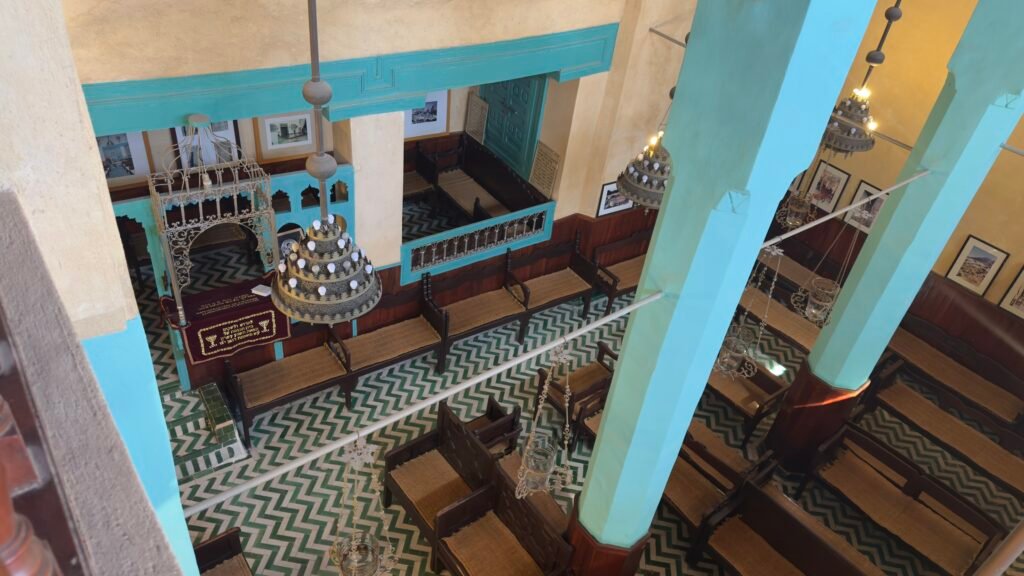
The Marrakech Mellah lies next to the Bahia Palace and the El Badi Palace in the south of the medina. Its centerpiece is the Lazama Synagogue, whose founding is traced to Jews who arrived from Spain after 1492. Its blue-and-white courtyard is still used for prayer, and nearby is the large Miara Jewish cemetery. Walking the Mellah with a guide, you see the different street layout and the old balconied houses that set it apart from the rest of the medina.
Plan this trip
Morocco's Jewish Heritage
A private 8-day journey through the Agafay desert, Essaouira, the High Atlas and Marrakech, with a focus on Morocco's Jewish heritage.
View the Tour Plan on WhatsApp Email UsFez: Morocco’s oldest Mellah
The Fez Mellah, built next to the Royal Palace in the 15th century, is the first and oldest Jewish quarter in Morocco and gave its name to all the others. Look for its wooden balconies facing the street, unusual in a Moroccan medina. The 17th-century Ibn Danan Synagogue has been restored and can be visited, and the Jewish cemetery with its rows of white tombs is close by.
Fez is on many of our routes, including the Classic Morocco tour and the Imperial Cities tour, where the guided medina day passes through the Mellah.
Casablanca: the Museum of Moroccan Judaism
Opened in 1997, the Museum of Moroccan Judaism in Casablanca is described as the first museum in the Arab world dedicated to Jewish heritage. Its collection of ritual objects, clothing, photographs and a reconstructed synagogue interior gives a good overview before or after visiting the mellahs. It is an easy stop on your first or last day if you fly into Casablanca.
Other places with Jewish history
- Tangier: synagogues and an international history shaped by Sephardic families.
- Meknes and Rabat: both have historic mellahs near their royal palaces.
- The Atlas and the south: Jewish communities once lived in Berber villages across the mountains and the Draa Valley, and some old kasbahs and cemeteries remain.
A Jewish heritage itinerary
Our 8-day Morocco Jewish heritage tour is built around these places. It starts in Marrakech with a night in the Agafay Desert, then spends two nights in Essaouira, including the Mellah, the Haim Pinto Synagogue, the cemetery and Bayt Dakira. Two nights in the High Atlas Mountains follow, with walks to Berber villages, then two days in Marrakech for the Mellah and the Lazama Synagogue.
To include Fez and Casablanca, we can extend the route. Our 10-day Classic Morocco tour already covers Casablanca, Fez and Marrakech, and every private tour can be tailored with more time in the mellahs.
Practical tips
- Dress modestly when visiting synagogues and cemeteries, with shoulders and knees covered. Men may be asked to cover their heads.
- Synagogues are closed on Shabbat and Jewish holidays, so plan visits for Sunday to Friday morning.
- Go with a guide. Many sites are kept by caretakers, and a local guide makes sure doors are open and the stories are told.
- Kosher food is limited outside Casablanca, so let us know your dietary needs early and we will plan meals around them.
Frequently asked questions
Is Morocco welcoming to Jewish travelers?
Yes. Many Jewish visitors come every year, including Israelis and descendants of Moroccan families, and Jewish heritage sites are protected and restored with state support.
Are there still Jewish communities in Morocco?
Yes, though they are small. Casablanca has the largest community, with active synagogues and kosher restaurants.
Can you combine Jewish heritage with the Sahara?
Yes. We can add the desert to any heritage itinerary. Tell us what you would like to see, or browse all our private Morocco tours.
Plan this trip
Morocco's Jewish Heritage
A private 8-day journey through the Agafay desert, Essaouira, the High Atlas and Marrakech, with a focus on Morocco's Jewish heritage.
View the Tour Plan on WhatsApp Email Us