
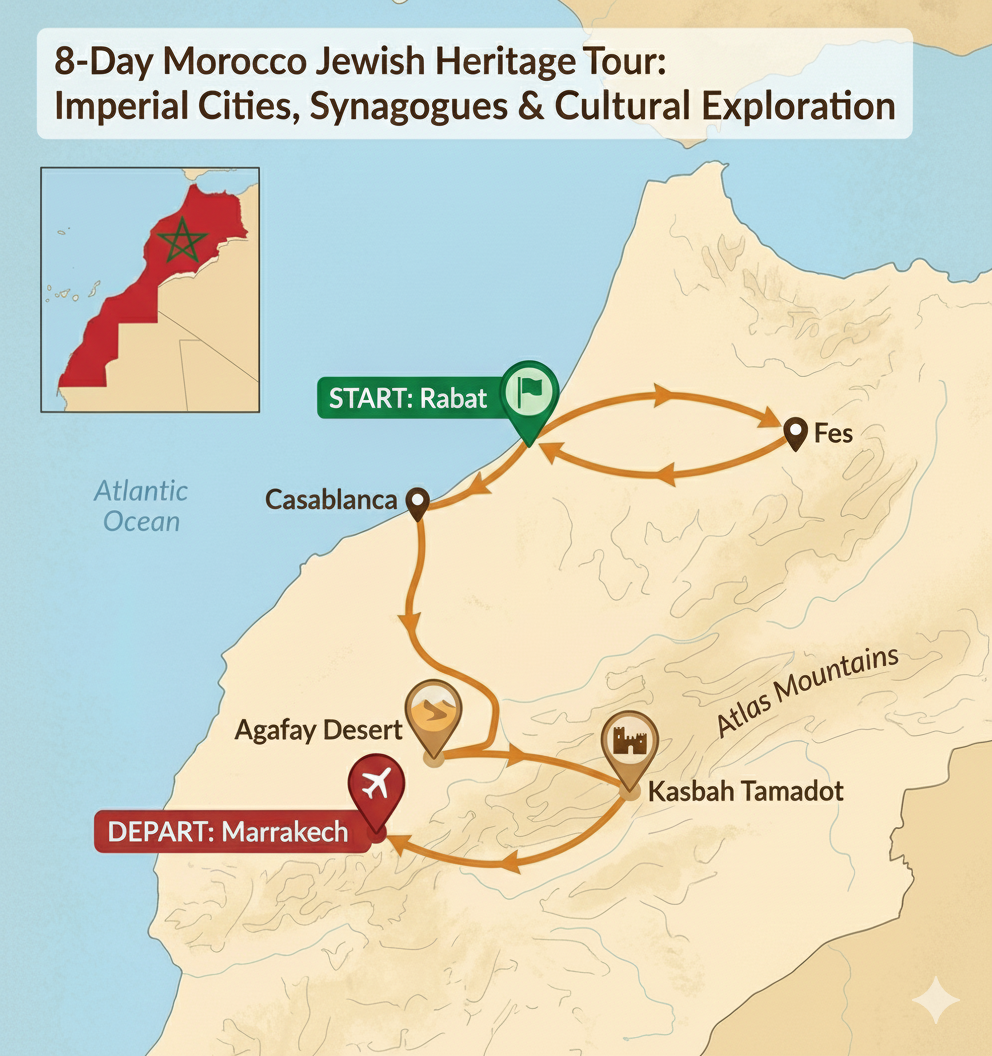
8-Day Morocco Jewish Heritage Tour: Imperial Cities, Synagogues & Cultural Exploration

- 8 Days
Description
Embark on a profound journey through Morocco’s rich Jewish heritage, exploring the deep historical connections between Jewish and Muslim communities that have shaped this North African kingdom for over two millennia. This specialized 8-day tour is designed for Jewish travelers, history enthusiasts, and anyone interested in understanding Morocco’s multicultural legacy through visits to historic synagogues, Jewish quarters, cemeteries, and sites connected to legendary Jewish scholars.
Morocco was home to one of the world’s most significant Jewish communities, with roots extending back over 2,000 years. At its peak in the 1940s, Morocco’s Jewish population exceeded 250,000. Though most emigrated to Israel and other countries in subsequent decades, Morocco maintains its synagogues, cemeteries, and Jewish quarters while celebrating this heritage as integral to national identity. This journey takes you to the most important Jewish sites in imperial cities Fez, Rabat, and Marrakech, combined with cultural experiences including wine tasting in Meknes, desert camping in Agafay, and mountain exploration near Mount Toubkal. Led by knowledgeable guides who understand both the historical significance and contemporary context, this tour provides meaningful connections to Jewish Moroccan heritage.
Duration
8 Days
Tour Type
Cultural Tours, Historical Tours, Jewish Heritage Tours, Religious Tours
Group Size
12
Language
English
Popular Features
- Expert Guides
- Heritage Sites
- Private Tour
- Synagogue Access
Highlights
- Visit Ibn Danan Synagogue in Fez, beautifully restored 17th-century landmark
- Explore El Fassiyin Synagogue, converted into a museum preserving Jewish legacy
- Pay respects at Bayt Lakim Jewish Cemetery with grave of martyr Solica Hatchuel
- Walk through Fez Mellah, Morocco's oldest Jewish quarter in Fez El Jadid
- Visit historical home of Moses Maimonides (Rambam), legendary Jewish philosopher
- Explore Al Quaraouiyine University exterior and traditional tannery quarter
- Wine tasting and gourmet lunch at Meknes vineyard
- Visit elegant Kasbah of the Udayas in Rabat with Andalusian-style architecture
- Visit Hassan Tower and Mohammed V Mausoleum in Rabat
- Sunset camel ride and luxury overnight in Agafay Desert camp
- Day trip to Imlil in High Atlas Mountains with Berber village walk
- Exclusive lunch at Richard Branson's Kasbah Tamadot
- Explore Marrakech's historic Mellah founded in 16th century
- Visit Al Azama Synagogue, active place of worship in Marrakech
- Optional visit to magnificent Ben Youssef Madrasa
- Time for hammam spa treatments and souk shopping
Included
- Private transportation throughout in comfortable air-conditioned vehicle
- English-speaking driver and specialized Jewish heritage guide
- 7 nights accommodation in carefully selected riads and hotels
- Daily breakfast at all accommodations
- Dinner on Day 1
- Lunch on Day 2, Day 3, and Day 6
- Dinner on Day 4
- Visit to Ibn Danan Synagogue in Fez
- Visit to El Fassiyin Synagogue museum
- Visit to Bayt Lakim Jewish Cemetery
- Comprehensive tour of Fez Mellah and medina
- Visit to Maimonides historical home (subject to availability)
- Wine tasting and gourmet lunch at Meknes vineyard
- Comprehensive tour of Rabat including Kasbah of Udayas
- Visit to Hassan Tower and Mohammed V Mausoleum
- Sunset camel ride in Agafay Desert
- Overnight in luxury Agafay desert camp with traditional dinner
- Guided walk through Imlil Berber village in Atlas Mountains
- Exclusive lunch at Kasbah Tamadot
- Comprehensive tour of Marrakech Mellah
- Visit to Al Azama Synagogue
- All entrance fees to Jewish heritage sites and monuments mentioned
- Airport pickup and drop-off (Rabat/Fez arrival, Marrakech departure)
- Bottled water in vehicle daily
- All taxes and service charges
Excluded
- International flights, Travel insurance , Drinks, Unmentioned meals, and any personal expenses
- International flights to/from Morocco
- Travel insurance (highly recommended)
- Meals and beverages not specified in itinerary
- Alcoholic beverages except wine tasting
- Personal expenses and shopping
- Tips and gratuities for guides, drivers, and hotel staff
- Optional hammam spa treatments
- Optional activities not mentioned
- Synagogue donations (customary but optional)
Travel Itinerary
Day 1 - Arrival and Introduction to Ancient Fez
Shalom and welcome to Morocco! Upon arrival at either Rabat-Salé Airport or Fez-Saïss Airport, you'll be warmly greeted by your specialized guide and private driver who will accompany you throughout this heritage journey. The drive from Rabat to Fez takes approximately two and a half hours through Morocco's agricultural heartland, while direct arrival in Fez requires just 20 minutes from the airport to the medina.
Check into your traditional riad accommodation tucked within Fez's ancient medina walls. These beautifully restored merchant houses feature ornate courtyards, carved cedar ceilings, and intricate zellige tilework, providing authentic Moroccan ambiance. After settling in and perhaps enjoying refreshing mint tea, embark on a gentle orientation walk through Fez El Bali, the Old City that ranks among the world's largest car-free urban areas. Your guide provides initial context about Fez's significance as Morocco's spiritual capital and former home to one of North Africa's most prominent Jewish communities.
Wander through winding alleyways discovering traditional life continuing much as it has for centuries—artisans practicing ancient crafts, shopkeepers arranging colorful displays, locals going about daily routines. This first glimpse of Fez's vibrant atmosphere, maze-like layout, and rich multicultural traditions prepares you for tomorrow's comprehensive Jewish heritage exploration. Return to your riad for dinner and overnight, anticipating the profound historical journey that awaits.
Day 2 - Comprehensive Jewish Fez - Synagogues, Mellah & Maimonides
Today brings profound immersion in Fez's extraordinary Jewish heritage, which flourished for over a millennium making this city central to Moroccan Jewish history and scholarship. After breakfast, begin with a visit to the Ibn Danan Synagogue, a beautifully restored 17th-century landmark considered one of North Africa's oldest and most significant synagogues. The synagogue's intricate interior features traditional Moroccan-Jewish architectural elements including ornate arches, painted ceilings, and carved wood details. Your guide explains the synagogue's history, its role in the community, and the restoration efforts that preserved this treasure.
Continue to the El Fassiyin Synagogue, also dating from the 17th century and recently converted into a museum dedicated to preserving Fez's Jewish legacy. Through artifacts, photographs, and exhibits, the museum tells stories of daily life, religious practices, and the once-thriving Jewish community that contributed significantly to Fez's commercial, intellectual, and cultural development. Proceed to the Bayt Lakim Jewish Cemetery, known for its distinctive white tombs covering the hillside. Here, pay respects at the grave of Solica Hatchuel, a young Jewish woman who became a powerful symbol of Jewish martyrdom in the 19th century. Her story—refusing forced conversion to Islam despite execution threats—resonates deeply with both Jewish and Muslim communities as representing religious conviction and interfaith respect.
Your tour continues through the Mellah of Fez, Morocco's oldest Jewish quarter established in the 15th century within Fez El Jadid district that also houses the Royal Palace. Walk streets where Jewish families lived for generations, discovering the distinctive architecture with characteristic wrought-iron balconies and communal spaces. Visit the exterior of Al Quaraouiyine University (founded 859 CE), the famous Chouara Tanneries where medieval leather-dyeing methods continue, bustling artisan workshops, and the vibrant food market. A special highlight is visiting the historical home of Moses ben Maimon—Maimonides or Rambam—the legendary 12th-century Jewish philosopher, Torah scholar, and physician who lived and studied in Fez. His house (subject to current owner permission) represents Morocco's role in Jewish intellectual history. Return to your riad for reflection on this emotionally rich day exploring Fez's Jewish soul.
Day 3 - Meknes Wine Country and Rabat Capital City
After breakfast, depart Fez for the Meknes wine-producing region, a surprising dimension of Moroccan culture with roots extending to Roman times. Morocco's wine industry, though relatively unknown internationally, produces quality wines that have won international recognition. The Jews of Morocco historically played important roles in wine production before and during the French Protectorate period. Arrive at a carefully selected vineyard for a guided tour of the estate and cellars, learning about winemaking in Morocco's unique climate and terroir.
The experience culminates in a wine tasting featuring multiple varietals—typically reds, whites, and rosés produced from both international and local grape varieties. Pair your tasting with a gourmet lunch prepared from fresh local ingredients, often featuring French-Moroccan fusion cuisine that reflects the country's culinary evolution. This relaxed indulgent interlude in beautiful rural surroundings provides welcome contrast to the intensity of yesterday's emotional heritage exploration. After lunch, continue to Rabat, Morocco's elegant coastal capital chosen as such in 1912. The city's boulevards, gardens, and orderly layout reflect French colonial planning combined with Moroccan architectural traditions.
Arrive by late afternoon and check into your hotel before visiting the enchanting Kasbah of the Udayas, a 12th-century fortress perched above the Atlantic Ocean and Bou Regreg River. Wander through its distinctive blue-and-white painted streets that evoke Andalusian atmosphere, discover peaceful Andalusian Gardens, and enjoy stunning ocean views from the terrace. This kasbah represents Morocco's connection to Islamic Spain, where Jewish communities also flourished before the Inquisition. Spend the evening at leisure in Morocco's most cosmopolitan city, perhaps walking along the waterfront or through Rabat's modern ville nouvelle.
Day 4 - Imperial Rabat and Journey to Desert Camp
Begin your morning exploring more of Rabat's significant monuments. Visit the Hassan Tower, the iconic unfinished minaret of a 12th-century mosque that was intended to be the world's largest. Standing at 44 meters, the tower represents the architectural ambitions of Morocco's Almohad dynasty. Adjacent stands the magnificent Mohammed V Mausoleum, where Morocco's revered king is buried in a building showcasing the finest Moroccan craftsmanship—white marble, intricate zellige tilework, carved cedar, and an ornate interior watched by ceremonial guards in traditional dress. The site serves as a symbol of modern Morocco's sovereignty and respect for monarchy that helped preserve Jewish communities during challenging periods.
After your morning of cultural exploration, depart for the approximately four-hour journey south toward Marrakech and the Agafay Desert. This unique landscape differs dramatically from the golden Sahara dunes—Agafay features distinctive rocky, moon-like terrain of rolling hills and stone-strewn plains. Arrive at your luxury desert camp in the late afternoon, checking into comfortable tents with proper beds and private facilities. As the sun begins its descent, embark on a peaceful sunset camel ride across Agafay's golden ridges and quiet expanses. Experience the profound silence and vast scale of the desert landscape as light transforms the terrain through beautiful colors.
Return to camp as stars begin appearing in the clear sky. Gather for a traditional Moroccan dinner served under countless stars—the absence of light pollution reveals the Milky Way clearly visible. After dinner, perhaps enjoy Berber music around the campfire before retiring to your tent for a tranquil night surrounded by desert peace. This desert experience adds natural beauty and spiritual reflection to your heritage journey, connecting you to the landscapes that Jewish merchants once crossed along ancient caravan routes.
Day 5 - Desert Relaxation and Marrakech Introduction
Enjoy a slow and restful morning in Agafay, waking naturally to desert silence rather than alarm clocks. After breakfast with desert views, spend time relaxing by the pool if your camp features one, reading in peaceful surroundings, or simply absorbing the unique desert atmosphere before departing this tranquil setting. The slower pace this morning provides welcome respite, allowing reflection on the profound heritage sites visited and anticipation of Marrakech's Jewish history awaiting exploration.
Later in the morning, your driver transfers you to Marrakech, approximately one hour away. The sudden shift from desert quietness to urban energy creates a dramatic contrast as you enter Morocco's most famous city. Upon arrival, check into your riad or hotel in or near the medina. After settling in and perhaps enjoying lunch, begin an orientation tour featuring key Marrakech highlights. Visit the exterior of the Koutoubia Mosque, whose 77-meter minaret serves as the city's most recognizable landmark visible from across Marrakech. The mosque's name derives from "kutubiyyin" (booksellers), referencing the book market that once flourished nearby—a trade in which Jewish merchants played significant roles.
Receive an overview of the historic medina's layout, helping you navigate independently later. Walk through main squares observing the vibrant street life that characterizes Marrakech. As evening approaches, the famous Jemaa el-Fnaa square transforms into an outdoor spectacle with food stalls, performers, storytellers, and crowds creating extraordinary energy. Your guide provides cultural context before leaving you to explore at leisure. The evening is free to wander, shop, or simply observe Marrakech's intoxicating atmosphere from a rooftop café. Return to your accommodation anticipating tomorrow's dedicated Jewish heritage exploration.
Day 6 - Atlas Mountains Village Walk and Luxury Kasbah Lunch
Today brings a complete change of scenery as you journey from Marrakech into the dramatic High Atlas Mountains. After breakfast, drive approximately one and a half hours south toward the village of Imlil, gateway to Mount Toubkal—North Africa's highest peak at 4,167 meters. The route climbs steadily through changing landscapes, passing traditional Berber villages built into mountainsides and terraced gardens where locals grow vegetables, fruit trees, and walnuts using ancient agricultural techniques.
Arrive in Imlil and embark on a short walk through the village and surrounding areas, experiencing traditional mountain life that has changed little over centuries. Your guide explains Berber culture, Islamic and Jewish historical presence in these mountains (Jewish traders once traveled these routes), and how communities adapt to harsh mountain conditions. The crystal-clear air, stunning vistas of snow-capped peaks (in winter and spring), and warm hospitality create lasting impressions. Children may accompany you, and villagers often invite visitors to share mint tea in their homes—the foundation of Moroccan hospitality regardless of religion.
After your mountain walk, continue to the renowned Kasbah Tamadot, an iconic luxury retreat owned by Sir Richard Branson. This former kasbah has been transformed into one of Morocco's most exclusive properties, combining traditional Moroccan architecture with world-class service and amenities. Enjoy a memorable and luxurious lunch featuring refined Moroccan-international cuisine, served on terraces with breathtaking Atlas Mountain panoramas. The experience represents modern Morocco's tourism evolution while honoring traditional aesthetics. Return to Marrakech by late afternoon, leaving the evening free for relaxation, optional traditional hammam spa experience, or wandering the medina independently. Overnight at your accommodation, preparing for tomorrow's exploration of Marrakech's Jewish heritage.
Day 7 - Marrakech Jewish Quarter, Synagogue and Cultural Sites
Today is dedicated to exploring Marrakech's vibrant Jewish heritage, which differs from Fez's ancient scholarly traditions by reflecting more recent history of commerce, craftspeople, and the dramatic population changes of the 20th century. After breakfast, begin with comprehensive exploration of the historic Mellah, Marrakech's Jewish quarter established in 1558 when Sultan Abdallah al-Ghalib relocated the Jewish community to an area adjacent to the Royal Palace. This proximity reflected both protection and the important economic role Jews played as royal merchants, craftsmen, and advisors.
Walk through the Mellah's distinctive streets noticing architectural differences from Muslim quarters—taller buildings with characteristic wrought-iron balconies that allowed Jewish women to observe street life while maintaining modesty traditions. Your guide explains daily life, commercial activities, synagogue locations, and the multicultural exchanges that occurred despite religious separation. At its peak in the 1940s, Marrakech's Mellah housed over 30,000 Jews; today only a few dozen remain, mostly elderly. Visit the Al Azama Synagogue (also called Lazama Synagogue), which continues serving as an active place of worship and community center. The synagogue features a peaceful courtyard and traditional interior elements. If timing permits, you may attend services or meet with community members sharing stories and perspectives.
The afternoon offers flexibility based on interests. Options include visiting the magnificent Ben Youssef Madrasa, a 16th-century Quranic school representing the pinnacle of Moorish architecture with its ornate courtyard perfect for understanding Islamic educational traditions that paralleled Jewish yeshiva study. Alternatively, indulge in a traditional hammam spa treatment—these public baths historically served both Muslim and Jewish communities. Browse the souks independently for shopping, now understanding the historical Jewish role in Marrakech's commercial life (jewelry, textiles, spices). Your evening is free to explore at leisure, perhaps enjoying a final walk through Jemaa el-Fnaa square or dining at a rooftop restaurant. Return to your accommodation for your final night, reflecting on the profound heritage journey connecting you to Moroccan Jewish history.
Day 8 - Marrakech Leisure and Farewell
Enjoy some final leisure time before your scheduled transfer to Marrakech Menara Airport for your departure flight. Depending on your flight schedule, you may have a few hours for last-minute activities. Perhaps take a final walk through the medina, visiting sites you missed or returning to favorite spots for final photographs and memories. Consider visiting artisan cooperatives to purchase quality Moroccan crafts—textiles, ceramics, leather goods, argan oil products, or traditional jewelry that once represented Jewish artisan trades.
Your accommodation staff can assist with any final needs—arranging purchases to be shipped internationally, currency exchange, or answering lingering questions about Moroccan Jewish communities and heritage sites. When it's time to depart, your private driver arrives for the transfer to the airport, located approximately 15-20 minutes from the medina depending on traffic. As you leave Morocco, you carry profound memories and insights from this heritage journey. You've walked in the footsteps of ancestors, visited synagogues that witnessed centuries of Jewish prayer, explored Jewish quarters that buzzed with Ladino and Arabic conversations, and paid respects at graves of martyrs and scholars who shaped Jewish Moroccan history.
This journey has revealed Morocco's remarkable tradition of convivencia—the coexistence of Jewish, Muslim, and Christian communities that created unique cultural synthesis. Despite historical challenges and eventual mass emigration, Morocco's commitment to preserving Jewish heritage sites, maintaining synagogues and cemeteries, and celebrating this multicultural legacy as integral to national identity remains strong. You depart not just with historical knowledge but with emotional connections to a heritage that bridges continents, centuries, and faiths. La'hitraot—until we meet again in Morocco.
Want to read it later?
Download this tour's PDF brochure and start your planning offline.
Frequently Asked Questions
Is this tour appropriate for non-Jewish travelers interested in history?
Absolutely. While designed specifically for Jewish heritage exploration, this tour welcomes anyone interested in Moroccan Jewish history, interfaith relations, and multicultural heritage. The sites provide profound insights into Morocco's diverse past and the remarkable coexistence traditions. Non-Jewish travelers often find this journey deeply educational and moving, revealing aspects of Moroccan history not typically covered in standard tours.
Will we meet with local Jewish community members?
We attempt to arrange meetings with community members, particularly in Marrakech where a small Jewish community remains active. However, availability depends on schedules, religious observances, and individual circumstances. In Fez, where the community has largely departed, we focus on historical sites. Synagogue caretakers and guides often share personal stories and perspectives about Jewish Moroccan life.
Are the synagogues still active or only historical sites?
Status varies by location. Al Azama Synagogue in Marrakech remains active for weekly Shabbat services and High Holy Days, serving the small remaining community plus Jewish tourists. Ibn Danan Synagogue in Fez has been restored primarily as a heritage site with occasional services. El Fassiyin now functions as a museum. All sites maintain respectful atmospheres and appropriate dress codes (modest clothing, head covering for men entering synagogues).
What is the best time of year for this tour?
This tour operates year-round, each season offering advantages. Spring (March-May) and fall (September-November) provide optimal weather. Avoid major Jewish holidays (Rosh Hashanah, Yom Kippur, Passover, Sukkot) when synagogue access may be limited and Jewish communities preoccupied with observances, unless you specifically want to participate in holiday services. Purim and Hanukkah are less restrictive. Summer (June-August) is very hot in desert and Marrakech but manageable. Winter (December-February) offers comfortable temperatures.
Is kosher food available?
Morocco does not have comprehensive kosher certification infrastructure. However, we can arrange vegetarian/fish meals at all accommodations if keeping kosher is important. The lunch at Kasbah Tamadot offers sophisticated vegetarian options. Some travelers bring packaged kosher items from home to supplement. The remaining Jewish community in Casablanca (not visited on this tour) maintains kosher facilities, and we can provide contacts if you're extending your stay.
How physically demanding is this tour?
This tour involves moderate walking through medinas on uneven surfaces, particularly in Fez's hilly terrain. The Imlil mountain walk is gentle and optional intensity. The camel ride lasts approximately 30-45 minutes each direction and can be replaced with 4x4 transport if needed. Overall, reasonable fitness allows comfortable participation. Most time is spent in vehicles, with breaks at sites. Discuss any mobility concerns when booking.
What is the current situation regarding Morocco-Israel relations?
Morocco normalized relations with Israel in December 2020 as part of the Abraham Accords. Direct flights now operate between Casablanca/Marrakech and Tel Aviv. Israeli passport holders can visit Morocco without restriction. The normalization has increased Jewish tourism and renewed interest in heritage preservation. King Mohammed VI maintains Morocco's long tradition of protecting Jewish heritage, continuing his father Hassan II and grandfather Mohammed V's policies that saved Moroccan Jews during World War II.
Will we learn about Muslim-Jewish coexistence traditions?
Yes, this theme runs throughout the tour. Your guide explains dhimmi status (protected religious minorities) in Islamic law, the convivencia traditions of shared cultural spaces, economic interdependencies, shared celebrations, and mutual influences in architecture, music, and cuisine. The tour highlights both positive coexistence examples and periods of difficulty, providing balanced historical perspective. Morocco's protection of Jews during World War II represents a proud moment of interfaith solidarity.
Can this tour be customized to visit specific family heritage sites?
Yes, if you have Moroccan Jewish ancestry and know specific locations (cities, cemeteries, family homes), we can customize the itinerary to include them. Provide family history details when booking—surnames, city of origin, approximate departure dates. We'll research and attempt to locate relevant sites. Many Moroccan Jews descended from families in Fez, Marrakech, Casablanca, Essaouira, and smaller towns. The Jewish Museum in Casablanca maintains genealogical resources we can contact.
What about photographing in synagogues and cemeteries?
Photography policies vary. Most synagogues allow respectful photography without flash. Always ask permission before photographing inside synagogues or at cemeteries. Never photograph people without permission. Jewish cemeteries require respectful behavior—if visiting, men should cover heads, avoid stepping on graves, and photographs should focus on historical/architectural aspects rather than treating sites as mere tourist attractions. Your guide will explain appropriate protocols at each location.
From$ 0.00
Book This Tour
Contact Information
Have a question in mind
Looking for more info? Send a question to the tour agent to find out more.
You might also like
Morocco is our passion. We design unforgettable journeys across the country. If you don’t see the perfect tour here, we’ll gladly customize one for you!